Posts

Why bonds must be always part of our overall portfolio mix

If one's retirement horizon is quite far away, they need not invest any retirement money in bonds. Bond's long term REAL (after inflation) returns are too low (just 2%) as compared to that of stocks (which is 7%). Note that above suggestion of not keeping any retirement savings in bonds for younger (below mid fifties) workers comes with a caveat. It's only meant for savvy  investors (with higher risk tolerance ) who are able to effectively manage pain of loss during stock market downturns and stay course  without losing any sleep. With 100% stock portfolio, pain of loss is expected to be most severe . So, unless you believe in long term potential of stocks and are willing to exercise patient, don't try 100% stock portfolio. Rather, like typical  retirement saver, stay with target date retirement funds (which typically has decent bond allocation) so that short term losses during crashes is emotionally  better manageable for your lower risk tolerance. Near retiree (...
Invesco Taxable Municipal Bond ETF (BAB) - Special muni bonds called Build America Bonds

Special muni  bonds category called Build America Bonds  seems to offer very decent return as safe bond. For example, one of inexpensive etfs in this muni category, Invesco Taxable Municipal Bond ETF (BAB)  , offers 6% coupon rate for half of such bonds in it's portfolio. Overall coupon rate comes out to be in 4.25% range. This seems to have resulted in total return for this ETF for last 1,3,5,10  years timeframe to be in 7.5%  range. This is almost 3% higher  than Total Bond index for similar time horizons. These long term  muni bonds were mainly issued in 2009-2010 by states/municipalities to finance state level major projects to spur growth after 2008 great recession. Federal government has been providing significant (35%) subsidy  towards interest payment to bond issuer . This, in turn, enabled  these bonds to offer better  rates than traditional munis. BAB seems to have outperformed  broad bonds consistently since it's incepti...

How we are likely to witness crypto financial crisis similar to one seen during 2008 CDO financial crisis

"Only when the tide goes out do you discover who's been swimming naked." Quote by Warren Buffett. Perhaps applies to novice crypto speculators who have lost most of their so-called conservative  stable coin high yield savings investment. Perhaps this tide is just a beginning . Bank runs are contagious. Anyone with historical understanding of great depression era bank runs (when there was no concept of FDIC insurance) knows it.  Crypto investing space seems to be crowded by all these saving and loan fintechs involved with unrealistic high-yield  saving products (kind of like 1990 era Indian Kuber  chit fund paying 24% APR interest). Such kind of lending products are based on irrational  assumption that crypto currencies valuation will keep increasing to maintain such high yield. https://www.wsj.com/articles/fdic-scrutinizing-voyagers-marketing-on-safety-of-customer-deposit-accounts-11657212266?st=87j85augzujggle&reflink=desktopwebshare_permalink Also, recent ...

Vanguard Total Stock Market Index etf - VTI

Vanguard Total Stock Market Index etf (VTI) is ETF based on CRSP Total stock market model developed by top UChicago economists. It is a combined index of top 2500 stocks (based on market cap) representing almost 95% of the market cap of total stock market. Vanguard Total Stock Mkt Idx Adm (VTSAX) is underlying mutual fund for this ETF. If one wants to do automatic periodic monthly investment, one should buy VTSAX instead (as most of brokerage allow periodic investment in mutual fund only ). Money invested in a given company is proportional to their market cap weightage and so giant and large cap ones get most of money (70%) and rest goes to mid caps and small caps. S&P 500 based large cap stocks represent approx 70-75% of total domestic stock market capitalization and so investing into a mutual fund/etf based on this index provides a broad large cap  coverage for sure. However remaining 25-30% domestic stocks fall into mid cap (15-20%) and small cap (10-15%) market cap. ...

How remote work correlated single family real estate property price boom might be short lived

John Mondragon at the Federal Reserve Bank of San Francisco and Johannes Wieland at the University of California, San Diego, estimate that remote work fueled a 15 percent rise  in house prices over the two-year period  that ended in November 2021.  That’s almost half of the total price increase  for that period. Source: https://squaredawayblog.bc.edu/squared-away/remote-work-has-pushed-up-house-prices/ So, when we hear people being irrationally exuberant about single family real estate as next great investing option (or say contemplating moving to even bigger home from juicy investment perspective), remind yourself that recent increase is highly correlated to remote work and has very little to do with long term housing fundamentals. If corporate America starts requiring more team collaboration (and hence less remote work) as going forward trend, outer suburb single family home valuations are likely to go through correction cycle during next recession.  Savvy inv...

How highly leveraged investing could wipe out outsized 8 times compounded past gains after a typical 45% crash in technology sector

Image
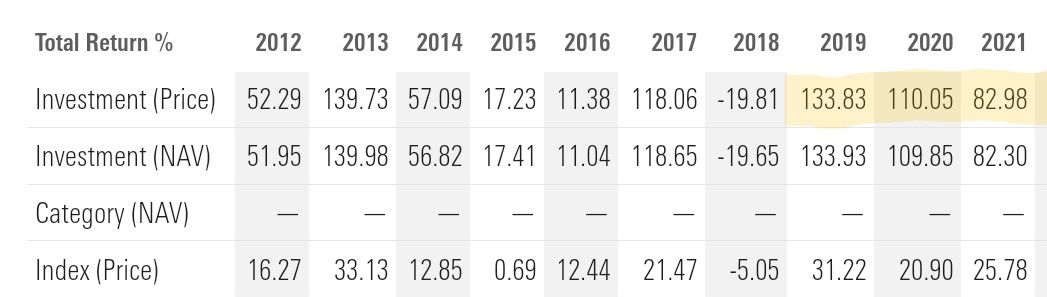
Highly leveraged ETF TQQQ performance has been mind boggling ( almost doubling each year) for 2019, 2020 and 2021: Source: Morningstar Performance Tab  Fantastic 8 times compounded gain for anyone invested in it during these 3 years. However, it takes one single typical crash of 45% in technology asset class to wipe out all this outsized gain.  For example, down the lane, if we do witness recession in 2022, perhaps we could see typical median  broad Total Stock crash of 35% YTD drop. Technology heavy QQQ is likely to decline by 45% YTD. In that case, triple leveraged TQQQ is likely to lose 90% YTD. What is performance number for above typical crash scenario?  Initial 10K invested in TQQQ in beginning of 2019 would be worth 80K by end of 2021. Fabulous return so far. However, above YTD 90% drop for 2022 would reduce that 80K to just 8K. In essence, one is in net loss of 20% of original 10K investment, in spite of 3 years of yearly doubling.  That'...

William Bengen’s seminal study about 4.5% Safe Withdrawal Rate for 30 years of inflation adjusted retirement income

Most commonly used retirement income planning strategies use actual expences , which I believe is more practical and includes one's spending habits and chosen life style. One of the most popular strategy uses 55/45 stock/bond conservative  retirement portfolio equal to 22 times  of desired initial yearly  needed expences (after accounting social security benefits). For example, say someone retires at age 67 and starts collection 50K social security benefit as joint household. With fully paid house, say household expences are 60K per year. So household needs remaining 10K from retirement portfolio to meet all expenses. Using above rule of 22, one just needs 220K (22*10K) portfolio to provide needed retirement income for rest of retirement years. Now, let's visit other scenario where household wants to retire earlier , say by age 62. Social Security benefits are reduced (25%) to around 40K per year in that case. Now household needs retirement portfolio to provide remaining ...