Posts

Showing posts with the label Tax

Why it is not tax advantageous to make long term after-tax contribution to 401(k) or IRA

Tax advantage is not that great for after-tax  contribution when not converted to Roth. Even though tax liabilities for growth from capital gains and reinvested dividend is deferred, eventually gains gets taxed at higher  ordinary income tax rate at withdrawal. Taxable brokerage account is perhaps better tax optimized for after-tax dollars. Capital gains are deferred here too, especially for passive index (which rarely do any capital gains distribution). When we withdraw, we pay lower  capital gains tax or perhaps no taxes for middle class lower tax bracket household . For example, Vanguard Total Stock Market ETF (VTI) has distributed only 1.5% yearly (just for dividends), even though it grew 9% annually since 2001. So 85% of growth has been tax deferred, even in taxable account.
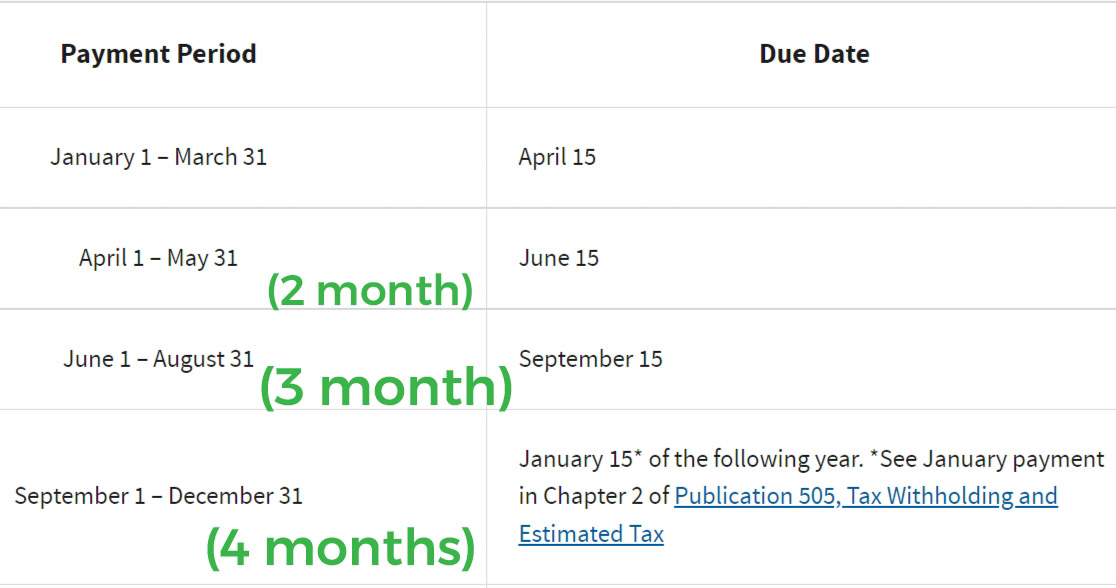
Estimated federal tax payment schedule follows interesting 2-3-4 months pattern after 1st quarter

Image
I had to pay some estimated taxes for realized long term capital gains I had during last quarter of year. I was under impression that we typically need to pay at end of each quarter with 15 days grace period after quarter ends. But, it's not necessarily true . It seems to be following interesting 2,3,4 months schedule as below: Source: https://www.irs.gov/faqs/estimated-tax/individuals/individuals-2 First quarter of year does follow end of quarter plus 15 days rule. Later due dates don't follow calendar quarterly schedule at all. They follow 2 months, 3 months and then 4 months period segments. We can pay federal estimated taxes by going to IRS tax account login (using ID.me login now) here . My state MA  estimated tax payment follows same schedule as above one for federal. Perhaps other states do same.  We can pay MA state estimated tax by going to MassTaxConnect - MA DOR Estimated Tax Payment site here . MA tax rate is 5% of taxable income.

How to qualify for tax free dividends and long term capital gains in taxable account

Image
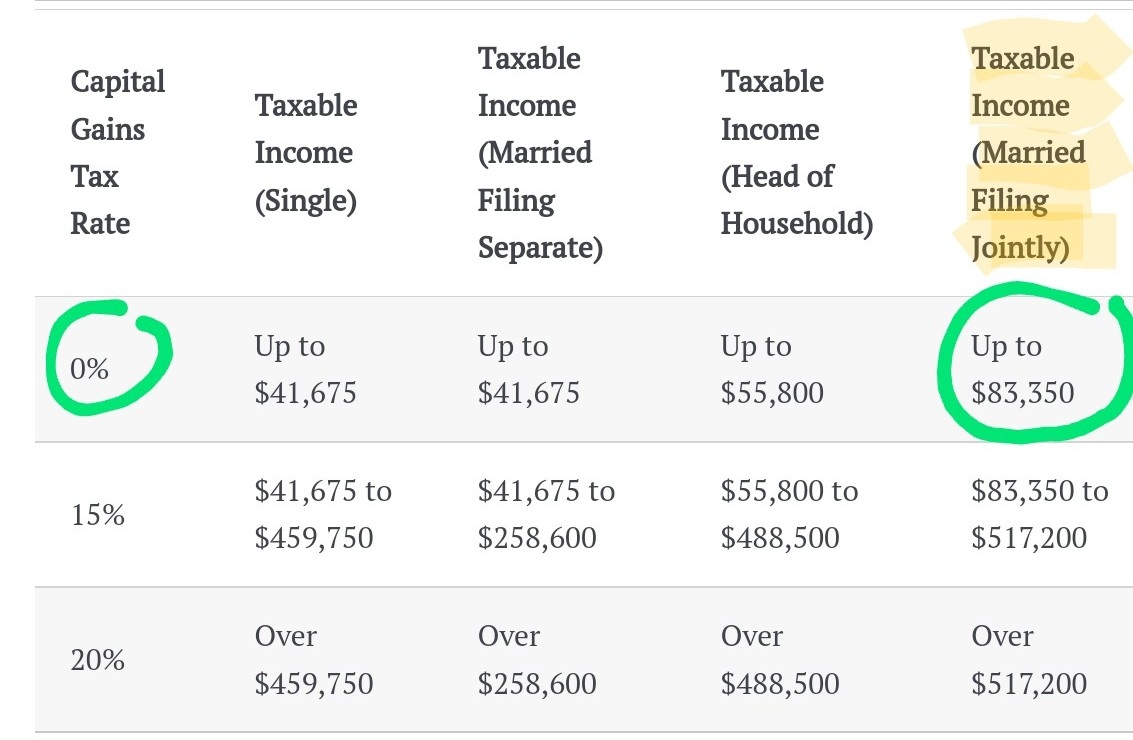
Long term  capital gain and dividends is tax free  for middle class household. Middle class here means households falling in lower 12%  tax bracket.  For example, joint household with up to $85,500 taxable  income in 2022 fall into lower 12% tax bracket. Similarly, households with almost similar income also qualify for tax free capital gains: Source: https://www.kiplinger.com/taxes/capital-gains-tax/603735/2022-capital-gains-tax-rate-thresholds Note that above threshold is for taxable income. Gross income threshold is much higher after adjusting for standard deduction and other tax deferred plan contributions. See  what gross income qualifies one to be in lower bracket  for more detail. Trick is to try to contribute enough in tax deferral plans such as 401(k) and traditional IRA (say, for spouse without access to 401k at work or full time mom/dad) to bring your household tax bracket to lower 12% tax bracket.  Same threshold as above ...

What gross income qualifies one to be in lower tax bracket

Image
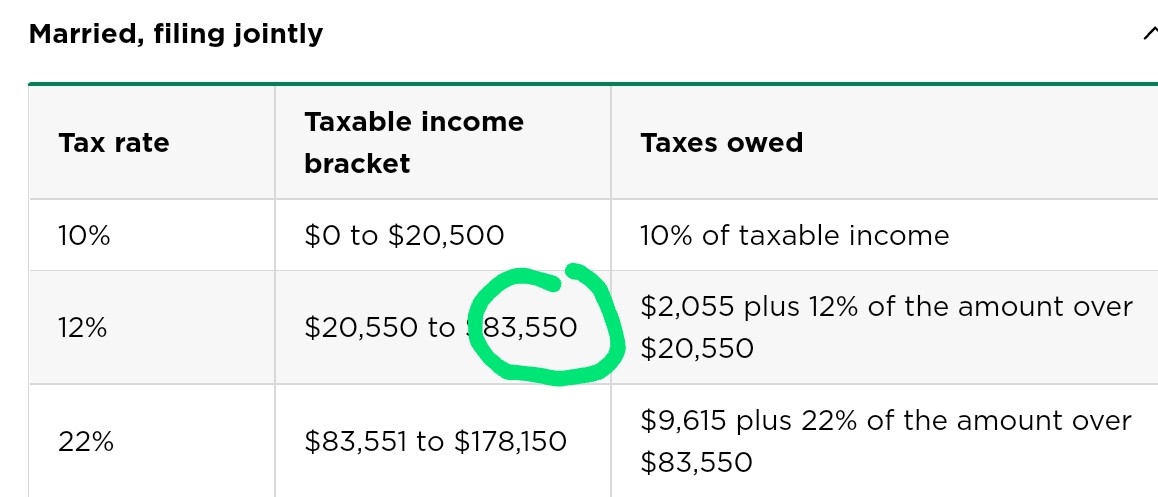
Joint household with 150K ( 163K  for  50+ age group)  gross income could be still in  lower 12%   tax bracket. Wondering as how is this possible? Well,  standard deduction  for married filing jointly  for tax year 2022 rises to $26K .  With this deduction, higher tax bracket of 22% kicks in as we cross threshold 83.5K  of taxable income: Source: https://www.nerdwallet.com/article/taxes/federal-income-tax-brackets So in essence, joint household is in lower  tax bracket for first 26K+83.5K= 109.5K  gross income for year 2022.  I found Engaging Data  web site to be easy to use resource for one to visually see one's tax bracket with full breakup of above kind of data: https://engaging-data.com/tax-brackets/ Now, we have tax deferral room of 20.5K  ( 27K if 50+ age) for each  401(K) participant in the household. So, if both members of joint household contributing max 20.5K to 401(k) plan, t...

Why I prefer ETFs over Mutual funds

Index based etfs are in general highly tax efficient as compared to it's mutual fund counterpart. It's because ETFs rarely generate any capital gain , even when index's underlying appreciated security is being replaced by another security. For example, VTI has not distributed any capital gain for it's 20 year's history, even though it has produced above 10% annual return during above period. Even during 2019 March selloff, there was no realized capital gain. For taxable accounts, it's better to own etfs than mutual funds, as taxes on deferred capital gains are deferred in etfs. Also, unlike mutual funds, there is no huge realized capital gains from other investor's panic selling during sharp downturn. There is no real outflow in case of etfs. Sellers sell shares and buyers buy them. Underlying securities remain unchanged .