Posts

Showing posts with the label Stocks

ProShares Ultra Semiconductors etf (USD) - Highest performing 1X margin based leveraged equities etf for last 3, 5, 10, 15, 20 years period

After good success of my last 5 year's experiment with chip sector's SOXX with disciplined buying low and waiting and prime harvesting strategy, finally I have decided to experiment with ProShares Ultra Semiconductors etf ( USD ) too for smaller 8% of my portfolio in my wife's Roth. ProShares has managed to negotiate a very low margin borrowing cost for USD etf of just Prime minus 1.5% (cheaper than my heloc) for it's 1X margin loan.  Also, in spite of less risky double leverage, it has managed to outperform triple leveraged chips etfs such as SOXL for last 3, 5, 10, 15, 20 years period.  One might lose 80% of one's money in next chips market crash. However, if one is brave hearted and doesn't panic sell, 10K invested in USD ETF on inception in 2007 would be over million dollars (1.22 millions as per Gemini) now. In spite of losing 80% in 2008 great recession , it has produced amazing 30% annual return in last 20 years. Once we exclude great financial crisis...

Growth vs Momentum stock investing - Comparison of a a top performing Growth fund with a top performing Momentum fund

By analyzing overall characteristics of top performing *growth* style etf, such as iShares Russell Top 200 Growth ETF (IWY), with top performing *momentum* style etf, such as Invesco S&P 500 Momentum ETF (SPMO), I have learnt one thing for sure. Growth style seems to have produced similar return as momentum style for long term (5, 10 years) horizon with comparatively much *lower risk*.  Growth fund (such as IWY) has mostly beaten broad market index every year since it's inception in 2009. However, momentum one (such as SPMO) keeps disappointing every other year by underperforming broad market.  So, for more aggressive investing strategy (say 20% of your stock portfolio), when it comes to choosing between growth and momentum, growth seems to be better option.

Invesco S&P 500 Momentum ETF (SPMO) - Excellent momentum strategy based inexpensive passive index fund for bravehearted

Invesco S&P 500 *Momentum* ETF (SPMO) seems to have produced *fantastic* total return as compared to Total Stock index. It is an excellent momentum strategy based inexpensive *passive* index fund for *bravehearted*.  It selects top 20% (around 100) companies from S&P 500 market cap index, factoring their last 12 months total return *momentum*. It allocates money based on *market cap* weightage as well as last year's total return *momentum*.  However, as de-risking strategy, it limits any single holding to 9% of portfolio to avoid just single company dominating it. With NVDA driven 45% return in 2024, it has produced annualized 20.57%, 19.83% and 17.77% for 3, 5 and 10 years periods as compared to VTI's  11.65%, 13.83% and 12.88% for same period. If we take out 2024 outperformance from equation, it's returns are similar to growth based IWY. However, above return comes with some added risk. It seems that every year when it outperforms broad market index, it underpe...

Invesco QQQ Trust ETF (QQQ) - Why this ETF is not that great due to it's NASDAQ exchange biase

I don't like this concept of exchange biased *NASDAQ 100* index which Invesco QQQ Trust ETF (QQQ) follows. It does not make any sense to just *favor* one exchange over other. There are better *large cap growth* options (such as IWY) which don't have such weird bias. QQQ has enjoyed great ride of technology sector revolution of last 15 years. However, technology sector *lagged* quite a bit during previous decade of dot com bust. Having better *diversified* (without any *exchange bias* ) large cap growth fund, such as IWY, is perhaps safer bet.

The Technology Select Sector SPDR Fund etf (XLK) - Top notch inexpensive passive technology sector etf

When it comes to *pure technology* sector based passive index fund, I believe Technology Select Sector SPDR Fund etf (XLK) is pretty solid long term choice. This inexpensive (expense ratio 0.09%) passive etf tracks all the technology sector companies within S&P 500.  It caps weightage of top mega caps to max 50% of it's portfolio to *avoid overconcentration* to just few momentum mega cap technology stocks. Also, no single stock can weigh more than 23%.  Above *checks and balances* in capping individual *high flying* stock weightage was one of the main reasons how this fund outperformed it's index during *2022 technology crash*. It's losses were 10-15% less than it's index that year. It faired way better than it's index in dot com bust years too.  As always, consider limiting your investment into aggressive asset classes, such as technology, to max 20% of your stock equity holdings.

Roundhill Magnificent Seven ETF ( *MAGS* ) - *Equal Weight* concentrated exposure to so-called “Magnificent Seven” stocks

The Roundhill Magnificent Seven ETF ( *MAGS* ) offers *equal weight* concentrated exposure to the “Magnificent Seven” stocks – Alphabet, Amazon, Apple, Meta, Microsoft, Nvidia, and Tesla.  It's P/E of 29.70 is very similar to broad technology sector, which is good. However, it's projected long-Term earnings growth rate is 10% *poorer* than it's technology index. Perhaps these are *too big* to coninue replicating such earnings growth forever. Even though it has produced oversized return during last 1 year, it's going forward return potential seems to be lesser than it's broad technology index. Also, being so concentrated is also prone to higher risk. iShares Russell Top 200 Growth ETF ( *IWY* ) might offer better diversification and higher earnings growth potential. We discussed it in past here:  https://financial-well-being.blogspot.com/2022/01/iShares-Russell-Top-200-Growth-ETF-IWY-Best-passive-index-ETF-for-large-cap-growth.html However, don't be surprised if,...

Fidelity Fundamental Large Cap Core ETF(FFLC) - Excellent large cap blend active ETF with early focus on long lasting trends

Recently came across Fidelity Fundamental Large Cap Core ETF (*FFLC*) which has been very nicely outperforming it's large cap blend index. For example, it's annualized total return of 17% for last 3 years is just *double* of it's index.  Even though it's *actively* managed, it's expense ratio of 0.38% is as low as other inexpensive passive index funds.  It's P/E of 20 is 10% cheaper than it's underlying benchmark. Also, it's long term earning growth potential of 11% is 10% higher than it's benchmark. So, it has 10% more potential for total return alongside 10% discounted valuation. Best of both worlds. It's investment strategy involves investing primarily in equity securities. Identifying *early* signs of *long-term changes* in the marketplace and focusing on those companies that may benefit from *opportunities created by these changes* by examining technological advances, product innovation, economic plans, demographics, social attitudes, and ot...

Themes Generative Artificial Intelligence ETF (WISE) - Passive index for providing exposure to the provision of products and/or services that contribute to AI related industries

Image
Someone asked me if I know any good ETF for AI stocks. I did some digging and sharing my findings below: One can look into *Themes Generative Artificial Intelligence (WISE) ETF*. It's inexpensive passive index which invests into companies that have (or are expected to have) exposure to the provision of products and/or services that contribute to AI related industries.  As compared to broad technology index, WISE is 10% more expensive with P/E of 30. Perhaps one can try *slowly* building position in it by buying on dip during future downward cycles. For this index, companies are only eligible if they generate at least 50% of their revenues from activities which make use of technologies such as Artificial Intelligence (AI), Data Analytics and Big Data, Natural Language Processing and AI-driven services. Expect lots of volatility for this cutting edge technology sector. This is how it's last 6 months chart looks like:

SPDR® S&P Semiconductor ETF (XSD) - Excellent small cap semiconductor index fund

Recently I came across another *semiconductor* focused low cost index ETF which seems quite promising index. It's called SPDR S&P Semiconductor ETF ( *XSD*). Unlike iShares Semiconductor ETF SOXX ( https://financial-well-being.blogspot.com/2022/01/iShares-Semiconductor-ETF-SOXX-Passive-Semiconductor-technology-index.html ), which focuses primarily in *large* cap, XSD focuses into *small and mid* cap semiconductor companies of S&P Total index. It's *equal weighted* index and that's why it's average capitalization is in mid and small cap.Overall it's comparable or *even better* than SOXX. For example... - It's PE is comparable to that of SOXX - Dividend yield plus earnings growth of 16% as compared to lower 13% for SOXX - It's 3/5 year returns of 23/22% is 20% better than that of SOXX's 19/18%. It tracks *semiconductor small cap* sector which has been one of the top performer in technology sector with close to *20% annual return* for last 5, 10 an...

iShares MSCI India Small-Cap ETF (SMIN) - Top performing Emerging Asia Pacific index fund ETF

Going forward I am thinking to add an *Emerging* Asia Pacific market ETF called iShares MSCI India Small-Cap ETF ( *SMIN* ). It's *top performer* for last 3 and 5 years period with annual returns of 22% and 13% for this emerging market segment. With 22% long-term *earning growth* projections, it's expected to produce top long-term return. As *country specific* fund, it's certainly concentrated and is more expensive (0.75% expense ratio). However, unlike other top performer ETFs, it's focus is not specific to any hot speculative industry. Also, it's capitalization falls into *mid* cap (borderline large cap) range, making it less aggressive than typical small cap etf. It's P/E of 22 is 10% higher than typical India equity fund. However, it's long term earnings growth projection of 22% is 30% more than it's category. So it's total return potential is still way (20-30%) higher than typical India equity fund. I am planning to build more position into it...

Why bonds must be always part of our overall portfolio mix

If one's retirement horizon is quite far away, they need not invest any retirement money in bonds. Bond's long term REAL (after inflation) returns are too low (just 2%) as compared to that of stocks (which is 7%). Note that above suggestion of not keeping any retirement savings in bonds for younger (below mid fifties) workers comes with a caveat. It's only meant for savvy  investors (with higher risk tolerance ) who are able to effectively manage pain of loss during stock market downturns and stay course  without losing any sleep. With 100% stock portfolio, pain of loss is expected to be most severe . So, unless you believe in long term potential of stocks and are willing to exercise patient, don't try 100% stock portfolio. Rather, like typical  retirement saver, stay with target date retirement funds (which typically has decent bond allocation) so that short term losses during crashes is emotionally  better manageable for your lower risk tolerance. Near retiree (...

Vanguard Total Stock Market Index etf - VTI

Vanguard Total Stock Market Index etf (VTI) is ETF based on CRSP Total stock market model developed by top UChicago economists. It is a combined index of top 2500 stocks (based on market cap) representing almost 95% of the market cap of total stock market. Vanguard Total Stock Mkt Idx Adm (VTSAX) is underlying mutual fund for this ETF. If one wants to do automatic periodic monthly investment, one should buy VTSAX instead (as most of brokerage allow periodic investment in mutual fund only ). Money invested in a given company is proportional to their market cap weightage and so giant and large cap ones get most of money (70%) and rest goes to mid caps and small caps. S&P 500 based large cap stocks represent approx 70-75% of total domestic stock market capitalization and so investing into a mutual fund/etf based on this index provides a broad large cap  coverage for sure. However remaining 25-30% domestic stocks fall into mid cap (15-20%) and small cap (10-15%) market cap. ...

How a typical buy and hold investor could still benefit from disciplined buy the dip without speculatively market timing

Sitting on cash with an intension of buying later the dip is certainly speculative market timing  and rarely beats buy and hold  strategy.  However, if one wants to slowly  build position into some promising  (based on fundamentals such as excellent long term earnings growth  potential) asset class which happens to be currently overpriced  (say, significantly higher PE than Total Stock market index), then tactically  exchanging  Total Stock index position with that one could be good use of buying the dip strategy. I have been slowly building position (with max limit of 8% of my portfolio though) in semiconductor sector by buying 1% of my portfolio in SOXX on each 8% dip from my last buy. With technology sector being so volatile, 5 such limit orders got executed during last one year. With all these averaging of buying on dip, my average paid PE is close to 17 (same as current PE of Total Stock index). Source: How to Face Up to Buying the Di...

With Large Growth in crash territory now, it's wise to avoid temptation of market timing

Large growth, which typically holds over 50% in technology , has entered into crash territory today with around 22% drop from it's peak from Dec last year. Broad market, such as Vanguard Total Stock index, is still in correction territory with just 13% drop from it's peak.  Market hates uncertainty . We have enough share of uncertainties lately, such as pandemic surge in China, geo political crisis in Europe caused by war in Ukraine, global food inflation and associated geo political crisis in developing nations, just to name few.   This makes Central Banks job even harder in taming inflation and hence increases potential for global stagflation . It's natural in such scenario to have investor emotions of cutting losses by resorting to panic selling of stock equities, before it drops even further. However, savvy investing is all about managing emotion of such pain of loss . Long-term stock investing's contribution to our financial well-being depends a lot on how...

iShares Russell Top 200 Growth ETF (IWY) - One of best passive index ETF for large cap growth

Image
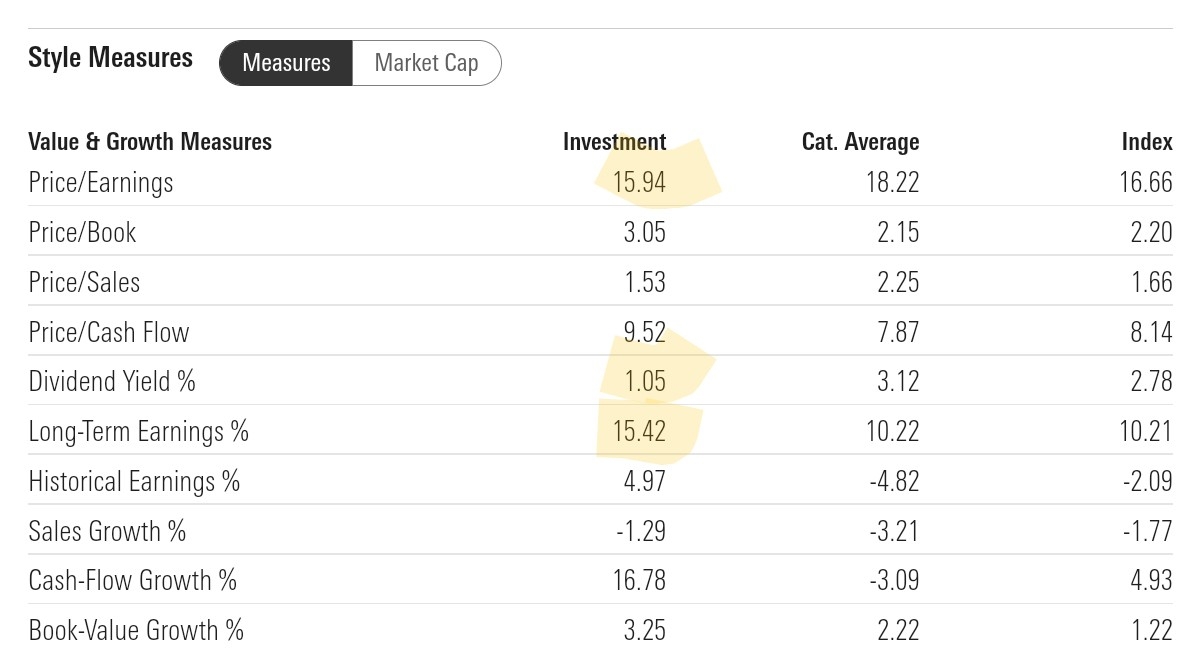
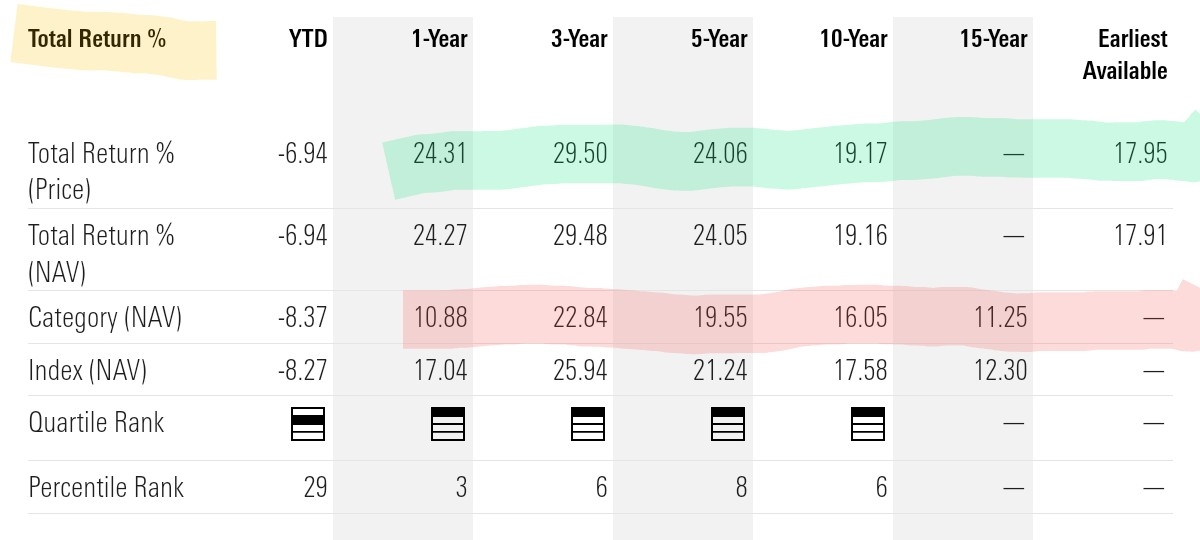
iShares Russell Top Growth ETF (IWY) is one of the best passive index ETFs for large cap growth asset class. It's quite inexpensive with expense ratio of just 0.20%. It has outperformed it's category by almost 25% for last 3,5,10 years period: Source: Morningstar Performance tab It's holdings are 12% cheaper (PE of 30 vs 34) than broad large cap growth index. It's projected long term earnings growth of 17% is quite comparable to that of it's index.  It's standard deviation of 18% is same as that of Total Stock index, even though it has outperformed   Vanguard Total Stock index by 50% in last 3,5 years period. Note that, as long term investor, my advice is to mostly stick with style-neutral broad market index. Styles come and go and those chasing today's hot style are mostly too late in the style game and eventually tend to lag.  As such, we can go for Large Growth factor bias for small portion of portfolio. My suggestion would be to go s...

Why I prefer Total Stock index over other factor based index for my ETFs/Mutual funds

Well known passive indices, such as Total Stock market index, seem to outperform active  funds by following one simple concept: Follow the leaders  in stock equities and allocate money proportional to how good they are doing. One of the simplest measure of success for a company is it's market cap . Accordingly, most indices allocate money to top n (as measured by market cap) companies in proportion to their market cap. Since industries (and it's associated leaders) change with time , it's pertinent to not get emotionally attached to any company. Investors tend to hang onto their losses from past leader holdings due to sunken cost fallacy. Similarly they tend to chase high flyers during boom times due to investor psychology called herd investing.  An emotionless data driven  index does not become victim to any of these investor psychology and keeps recalibrating  itself as leaders become laggards and new leaders emerge. There are several indices representing suc...

GlobalX US Infrastructure Dev ETF (PAVE) - Inexpensive infrastructure ETF with high return potential

Image
GlobalX US Infrastructure Dev ETF (PAVE) seems to be a good choice to capitalize on Biden's infrastructure bill spending for next couple of years. It has performed very well in it's domestic infrastructure category, since it's inception 4 years back.  It's PE ratio is 20% lower than that of broad Total Stock index, even though its long term earnings growth projection of 15% is quite similar to that of Total Stock index. It's expense ratio of 0.47% is little bit on higher side though. However, it's comparable to expense ratio of focused asset class such as infrastructure. Source: Morningstar Portfolio view page This fund seems to have outperformed Morningstar Gbl Eq Infrastructure index big way by mainly focusing into small/mid size growth-value blend industrial infrastructure companies. Hope it's able to do same in future. Above outperformance does come with some volatility  risk (standard deviation 25% as compared to 16% for index). Key is...

iShares Semiconductor ETF (SOXX) - Passive fund Based on Semiconductor technology index

For those considering a tilt  to specific technology  asset class in their portfolio, high PE of this asset class is always concerning. However, to my utter surprise, semiconductor  technology specific passive   iShares Semiconductor ETF (SOXX) happens to have dirt cheap  PE of merely 21 (as compared to 29 for technology heavy NASDAQ 100 - QQQ). Also, amongst all the technology asset class non leveraged etfs , SOXX performance is almost  number one  for all 1, 3, 5 years horizon. With dividend yield of over 1% and projected earnings growth of 17%, this ETF is projected to generate 1+17=18% annual return for next 5 years. It invests into ICE Semiconductor Sector Index which is primarily based on top 30 (based on market cap) global semiconductor companies. It's expense ratio of 0.43% is little bit on higher side. However, it's still one of least expensive focused technology index ETF.

Pulldown and Correction and Crash, Oh My! - Wizard of market turbulences

Every time our patience in buy-and-hold approach starts shaking due to emotional pain of loss during above turbulences, perhaps we need to remind ourselves that stocks are always volatile, but market eventually always recover. Several studies have proved that those who tried to time it have eventually lagged  the non-timers. I have seen over 30 pullbacks, 12 corrections and 2-3 bear markets in last 3 decades of my investing in stock funds. If I had tried timing all of these, my portfolio would have been perhaps just half of what it is. If we want to learn from history (all the best if you want to learn from your own mistakes of market timing), following chart might help in broadening our perspective about these short-lived pains ,which otherwise might seem quite long-lasting (without such perspective)

How I invested cash out money after refinancing our fully paid cars

Last month I re-financed our two fully paid cars with low 1.5% fixed rate for 7 years term from local credit union (DCU). For now I have parked this cash out into VTEB tax exempt muni bond fund. Going forward, I am planning to periodically (monthly) exchange this money from VTEB into Total Stock index fund ( VTI ) during next 16 months. I am hoping to dollar cost average in next 16 months and perhaps come out ahead in terms of timing (hopefully with some buy on low during some market correction in next 16 months).