Posts

Showing posts with the label Bonds

PGIM Ultra Short Bond ETF PULS - Good ultra short-term total bond fund ETF

PGIM Ultra Short Bond ETF (PULS) is a good low expense (0.15%) ultra short-term total bond fund ETF. It invests into investment grade (AA rated) corporate and government bonds with effective duration of 3 months. It offers 0.50-1% better return than AAA rated ultra short treasury bond ETFs such as SGOV. I believe such extra return might be worth, in spite of little bit lower rating. It's going forward yield to maturity is currently 6.04% Updated on Jan 12, 2025: PULS has continued outperforming it's underlying index 4 years in a row. It returned 6.12% last year (we discussed about it last year in Feb) as compared to ultrashort index's 4.39%. Hope it continues it's outperformance this year too.  This AA rated ultrashort (currently less than 1 month duration) Total bond fund ETF seems to be much better option than most of short term bank CD or high yielding savings account or most of money market funds. As Fed has cut interest rate few times last year, it's going forw...
Vanguard Core Bond ETF VCRB - Inexpensive Intermediate term Total Bond fund - Good substitute for Vanguard Total Bond Market ETF BND

I believe *actively* managed Vanguard Core Bond ETF (VCRB) is better substitute to 2 decades old *passive* (market value weighted) Vanguard Total Bond Market ETF (BND). In fact, market value of a bond offering doesn't make any sense to be a criteria to allocate more weight (allocation of money) to that bond offering. That's one reason why actively managed bond funds have been outperforming passive bond funds. Normally actively managed bond funds have higher expense ratio, but VCRB is an exception with just 0.10% expense ratio. As such, above bond fund should be used only for long haul investing such as in IRA or 401(K). Since they tend to be interest rate sensitive, we should *avoid* them for short term savings such as emergency funds. Updated on Feb 15, 2025: It outperformed it's *intermediate term* bond index during last 1 year by 1% (5.31% vs 4.38). Going forward, it's expected to return 5.15% based on it's yield to maturity.  I am glad I switched all my intermed...

iShares iBoxx $ Invmt Grade Corp Bd ETF (LQD) - Inexpensive Corporate Bond ETF

iShares iBoxx Investment Grade Corporate Bond ETF ( *LQD*) seems to offer 1% better return than Vanguard Total Corporate Bond ETF (VTC). Also it's bonds are better rated (A as compared to BBB) and it's expense ratio of 0.140% is comparable. Vanguard Interm-Term Corp Bd ETF (VCIT) has lower quality (BBB instead of A) and is less diversified. Accordingly, it should have produced better performance (than LQD) due to these added risks. But, it hasn't.

iShares 0-3 Month Treasury Bond ETF (SGOV) - Inexpensive ultra short term treasury bill ETF for emergency fund saving

iShares® 0-3 Month Treasury Bond ETF (SGOV) is ultra short term treasury bill ETF. It's expense ratio is near zero (just 0.07%) and it's latest (last 30 days) yield is 5.28%. Since it primarily holds US government bonds, this ETF is state and local tax exempt. Unlike CDs, there is no early withdrawal penalty. For saving money for emergency fund and short term goal expenses, SGOV seems like a good option. Since it is ultra short term bond fund, principal preservation is as good as any other money market fund.

Why bonds must be always part of our overall portfolio mix

If one's retirement horizon is quite far away, they need not invest any retirement money in bonds. Bond's long term REAL (after inflation) returns are too low (just 2%) as compared to that of stocks (which is 7%). Note that above suggestion of not keeping any retirement savings in bonds for younger (below mid fifties) workers comes with a caveat. It's only meant for savvy  investors (with higher risk tolerance ) who are able to effectively manage pain of loss during stock market downturns and stay course  without losing any sleep. With 100% stock portfolio, pain of loss is expected to be most severe . So, unless you believe in long term potential of stocks and are willing to exercise patient, don't try 100% stock portfolio. Rather, like typical  retirement saver, stay with target date retirement funds (which typically has decent bond allocation) so that short term losses during crashes is emotionally  better manageable for your lower risk tolerance. Near retiree (...

Invesco Taxable Municipal Bond ETF (BAB) - Special muni bonds called Build America Bonds

Special muni  bonds category called Build America Bonds  seems to offer very decent return as safe bond. For example, one of inexpensive etfs in this muni category, Invesco Taxable Municipal Bond ETF (BAB)  , offers 6% coupon rate for half of such bonds in it's portfolio. Overall coupon rate comes out to be in 4.25% range. This seems to have resulted in total return for this ETF for last 1,3,5,10  years timeframe to be in 7.5%  range. This is almost 3% higher  than Total Bond index for similar time horizons. These long term  muni bonds were mainly issued in 2009-2010 by states/municipalities to finance state level major projects to spur growth after 2008 great recession. Federal government has been providing significant (35%) subsidy  towards interest payment to bond issuer . This, in turn, enabled  these bonds to offer better  rates than traditional munis. BAB seems to have outperformed  broad bonds consistently since it's incepti...

Long duration bonds have been best performers in bond category, when we buy and hold them for long haul

As recently as 2011, bonds had earned higher returns than stocks  over the prior 30 years  ( long-duration  Treasury bonds, 10.7% annually; U.S. stocks, 10.4%). Source: https://www.wsj.com/articles/sometimes-its-bonds-for-the-long-run-1541176880?st=f5mipeo430wzfr5&reflink=desktopwebshare_permalink It seems that long duration  bonds have been best performers in bonds, when we buy and hold them for long haul . In short term, they might be most volatile  (due to higher sensitivity to interest rate changes).  So, if you are uneasy with recent under performance of long term bonds (such as PIMCO 15+ Year US TIPS ETF LTPZ  ), keep reminding yourself that such bonds are likely to be best bond performers, if you are willing to have patience and hold them for long haul.

Why it's good idea to hold bond funds for at least two years

Image
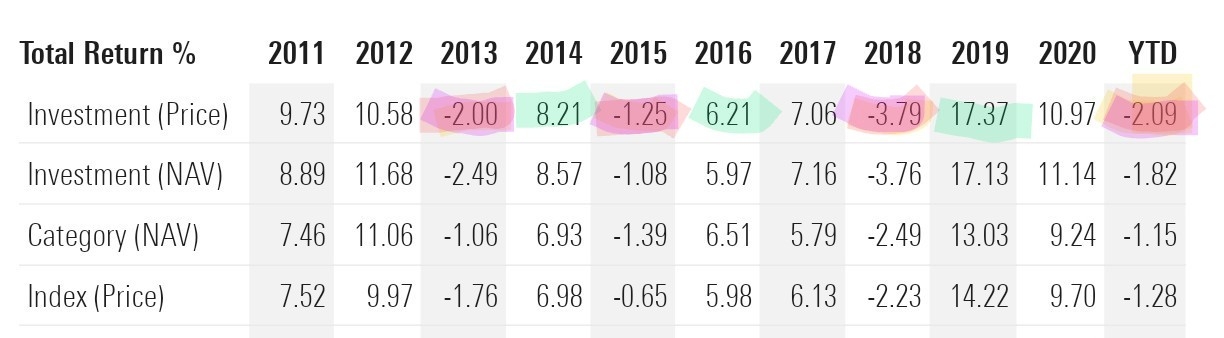
Are you frustrated with negative  YTD return of bond fund such as iShares iBoxx $ Invmt Grade Corp Bd ETF (LQD) and considering bailing out? If so, think twice  before bailing out. Bonds follow a pattern. Most of negative  return years are followed by oversized  return during subsequent year as seen below in year by year performance of LQD etf. So having little bit of patience could be your best friend when it comes to investing in bond funds. When held for 2 years , performance tends to revert to median  return.

Vanguard Tax-Exempt Muni Bond ETF - VTEB

Most of our emergency funding money is invested in muni fund called Vanguard Tax-Exempt Bond ETF (VTEB) . It's exempt from federal income tax. It's least expensive (0.06% expense ratio) muni ETF and contains highly diversified  investment grade national muni bonds. It's weighted coupon is excellent  (4.70%) and weighted duration is intermediate (hence less inflation sensitivity). It's federal tax free annual total return has been above 3%  since 2015 inception date. I have been lucky to get 5% annual return during last 3 years since I started investing in it. It's based on broader S&P National Municipal Bond Index.

PIMCO 15+ Year US TIPS Index ETF (LTPZ) - Excellent inflation protected treasuries (TIPS)

Image
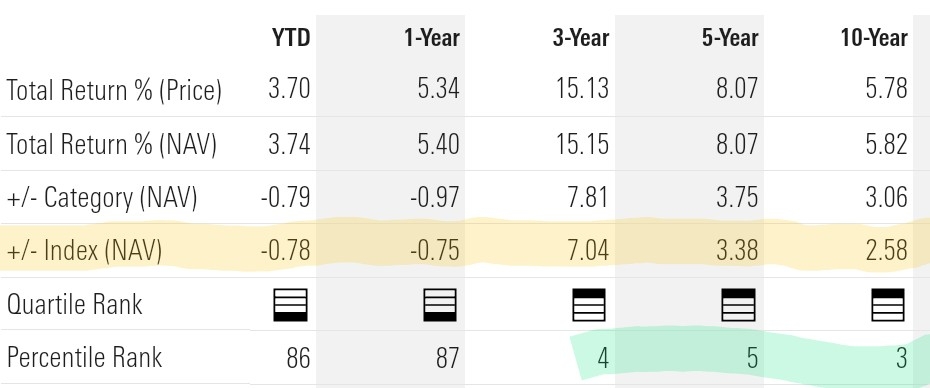
Last updated: May 25, 2022 While researching for alternate penalty free option in inflation protected treasuries called TIPS , I came across one excellent ETF called PIMCO 15+ Year US TIPS Index ETF (LTPZ) . Above inexpensive long duration TIPS ETF has produced top notch long term return. In fact, it's almost two to three times  that of Total Bond index. Source: Morningstar Performance Tab As an active fund, it has outperformed even standard TIPS index too. LTPZ outperformance comes at cost of more volatility than it's index. For example, it's standard deviation (measure of volatility) is almost 3 times of it's index: Source: Morningstar Risk tab When risk is taken out of the equation, the strategy's absolute performance looks more positive . On a 10-year basis, it has beaten  the category index on an annualized basis by 2.4%. So my advice for investors would be to ignore volatility in short term and give it two years of time . It's lik...