Posts

ProShares Ultra Semiconductors etf (USD) - Highest performing 1X margin based leveraged equities etf for last 3, 5, 10, 15, 20 years period

After good success of my last 5 year's experiment with chip sector's SOXX with disciplined buying low and waiting and prime harvesting strategy, finally I have decided to experiment with ProShares Ultra Semiconductors etf ( USD ) too for smaller 8% of my portfolio in my wife's Roth. ProShares has managed to negotiate a very low margin borrowing cost for USD etf of just Prime minus 1.5% (cheaper than my heloc) for it's 1X margin loan.  Also, in spite of less risky double leverage, it has managed to outperform triple leveraged chips etfs such as SOXL for last 3, 5, 10, 15, 20 years period.  One might lose 80% of one's money in next chips market crash. However, if one is brave hearted and doesn't panic sell, 10K invested in USD ETF on inception in 2007 would be over million dollars (1.22 millions as per Gemini) now. In spite of losing 80% in 2008 great recession , it has produced amazing 30% annual return in last 20 years. Once we exclude great financial crisis...

Growth vs Momentum stock investing - Comparison of a a top performing Growth fund with a top performing Momentum fund

By analyzing overall characteristics of top performing *growth* style etf, such as iShares Russell Top 200 Growth ETF (IWY), with top performing *momentum* style etf, such as Invesco S&P 500 Momentum ETF (SPMO), I have learnt one thing for sure. Growth style seems to have produced similar return as momentum style for long term (5, 10 years) horizon with comparatively much *lower risk*.  Growth fund (such as IWY) has mostly beaten broad market index every year since it's inception in 2009. However, momentum one (such as SPMO) keeps disappointing every other year by underperforming broad market.  So, for more aggressive investing strategy (say 20% of your stock portfolio), when it comes to choosing between growth and momentum, growth seems to be better option.

Invesco S&P 500 Momentum ETF (SPMO) - Excellent momentum strategy based inexpensive passive index fund for bravehearted

Invesco S&P 500 *Momentum* ETF (SPMO) seems to have produced *fantastic* total return as compared to Total Stock index. It is an excellent momentum strategy based inexpensive *passive* index fund for *bravehearted*.  It selects top 20% (around 100) companies from S&P 500 market cap index, factoring their last 12 months total return *momentum*. It allocates money based on *market cap* weightage as well as last year's total return *momentum*.  However, as de-risking strategy, it limits any single holding to 9% of portfolio to avoid just single company dominating it. With NVDA driven 45% return in 2024, it has produced annualized 20.57%, 19.83% and 17.77% for 3, 5 and 10 years periods as compared to VTI's  11.65%, 13.83% and 12.88% for same period. If we take out 2024 outperformance from equation, it's returns are similar to growth based IWY. However, above return comes with some added risk. It seems that every year when it outperforms broad market index, it underpe...

Invesco QQQ Trust ETF (QQQ) - Why this ETF is not that great due to it's NASDAQ exchange biase

I don't like this concept of exchange biased *NASDAQ 100* index which Invesco QQQ Trust ETF (QQQ) follows. It does not make any sense to just *favor* one exchange over other. There are better *large cap growth* options (such as IWY) which don't have such weird bias. QQQ has enjoyed great ride of technology sector revolution of last 15 years. However, technology sector *lagged* quite a bit during previous decade of dot com bust. Having better *diversified* (without any *exchange bias* ) large cap growth fund, such as IWY, is perhaps safer bet.

The Technology Select Sector SPDR Fund etf (XLK) - Top notch inexpensive passive technology sector etf

When it comes to *pure technology* sector based passive index fund, I believe Technology Select Sector SPDR Fund etf (XLK) is pretty solid long term choice. This inexpensive (expense ratio 0.09%) passive etf tracks all the technology sector companies within S&P 500.  It caps weightage of top mega caps to max 50% of it's portfolio to *avoid overconcentration* to just few momentum mega cap technology stocks. Also, no single stock can weigh more than 23%.  Above *checks and balances* in capping individual *high flying* stock weightage was one of the main reasons how this fund outperformed it's index during *2022 technology crash*. It's losses were 10-15% less than it's index that year. It faired way better than it's index in dot com bust years too.  As always, consider limiting your investment into aggressive asset classes, such as technology, to max 20% of your stock equity holdings.

Roundhill Magnificent Seven ETF ( *MAGS* ) - *Equal Weight* concentrated exposure to so-called “Magnificent Seven” stocks

The Roundhill Magnificent Seven ETF ( *MAGS* ) offers *equal weight* concentrated exposure to the “Magnificent Seven” stocks – Alphabet, Amazon, Apple, Meta, Microsoft, Nvidia, and Tesla.  It's P/E of 29.70 is very similar to broad technology sector, which is good. However, it's projected long-Term earnings growth rate is 10% *poorer* than it's technology index. Perhaps these are *too big* to coninue replicating such earnings growth forever. Even though it has produced oversized return during last 1 year, it's going forward return potential seems to be lesser than it's broad technology index. Also, being so concentrated is also prone to higher risk. iShares Russell Top 200 Growth ETF ( *IWY* ) might offer better diversification and higher earnings growth potential. We discussed it in past here:  https://financial-well-being.blogspot.com/2022/01/iShares-Russell-Top-200-Growth-ETF-IWY-Best-passive-index-ETF-for-large-cap-growth.html However, don't be surprised if,...

Janus Henderson AAA CLO ETF (JAAA) - Highest yielding inexpensive ultra short investment grade bank loan corporate bond fund

I recently added a bank loan bond fund called Janus Henderson AAA CLO ETF (JAAA) to my bond holdings. It's an ultra short duration corporate bond fund typically yielding equivalent to prime minus 1. These are bonds of mostly *AAA* rated leveraged buyout private equity companies who typically finance leveraged buyout by borrowing from banks. Banks then sell these to investors by securatizing them. These bonds are typically for 3-5 years maturity. However they are floating rate and so they are insensitive to interest rate changes. As private equity corporate bond fund, it's certainly riskier bond fund. However, none of AAA rated such loans defaulted during 2001 and 2008 mega crashes. So, I have decided to take my chances with it. It's Yield to Maturity is currently 7.03%. This is one of the highest yield for any ultra short investment grade corporate bond fund with low 0.22% expense ratio. It's not even sensitive to interest rate as coupon is adjustable rate. Updated on J...

Fidelity Fundamental Large Cap Core ETF(FFLC) - Excellent large cap blend active ETF with early focus on long lasting trends

Recently came across Fidelity Fundamental Large Cap Core ETF (*FFLC*) which has been very nicely outperforming it's large cap blend index. For example, it's annualized total return of 17% for last 3 years is just *double* of it's index.  Even though it's *actively* managed, it's expense ratio of 0.38% is as low as other inexpensive passive index funds.  It's P/E of 20 is 10% cheaper than it's underlying benchmark. Also, it's long term earning growth potential of 11% is 10% higher than it's benchmark. So, it has 10% more potential for total return alongside 10% discounted valuation. Best of both worlds. It's investment strategy involves investing primarily in equity securities. Identifying *early* signs of *long-term changes* in the marketplace and focusing on those companies that may benefit from *opportunities created by these changes* by examining technological advances, product innovation, economic plans, demographics, social attitudes, and ot...

PGIM Ultra Short Bond ETF PULS - Good ultra short-term total bond fund ETF

PGIM Ultra Short Bond ETF (PULS) is a good low expense (0.15%) ultra short-term total bond fund ETF. It invests into investment grade (AA rated) corporate and government bonds with effective duration of 3 months. It offers 0.50-1% better return than AAA rated ultra short treasury bond ETFs such as SGOV. I believe such extra return might be worth, in spite of little bit lower rating. It's going forward yield to maturity is currently 6.04% Updated on Jan 12, 2025: PULS has continued outperforming it's underlying index 4 years in a row. It returned 6.12% last year (we discussed about it last year in Feb) as compared to ultrashort index's 4.39%. Hope it continues it's outperformance this year too.  This AA rated ultrashort (currently less than 1 month duration) Total bond fund ETF seems to be much better option than most of short term bank CD or high yielding savings account or most of money market funds. As Fed has cut interest rate few times last year, it's going forw...

Themes Generative Artificial Intelligence ETF (WISE) - Passive index for providing exposure to the provision of products and/or services that contribute to AI related industries

Image
Someone asked me if I know any good ETF for AI stocks. I did some digging and sharing my findings below: One can look into *Themes Generative Artificial Intelligence (WISE) ETF*. It's inexpensive passive index which invests into companies that have (or are expected to have) exposure to the provision of products and/or services that contribute to AI related industries.  As compared to broad technology index, WISE is 10% more expensive with P/E of 30. Perhaps one can try *slowly* building position in it by buying on dip during future downward cycles. For this index, companies are only eligible if they generate at least 50% of their revenues from activities which make use of technologies such as Artificial Intelligence (AI), Data Analytics and Big Data, Natural Language Processing and AI-driven services. Expect lots of volatility for this cutting edge technology sector. This is how it's last 6 months chart looks like:

Vanguard Core Bond ETF VCRB - Inexpensive Intermediate term Total Bond fund - Good substitute for Vanguard Total Bond Market ETF BND

I believe *actively* managed Vanguard Core Bond ETF (VCRB) is better substitute to 2 decades old *passive* (market value weighted) Vanguard Total Bond Market ETF (BND). In fact, market value of a bond offering doesn't make any sense to be a criteria to allocate more weight (allocation of money) to that bond offering. That's one reason why actively managed bond funds have been outperforming passive bond funds. Normally actively managed bond funds have higher expense ratio, but VCRB is an exception with just 0.10% expense ratio. As such, above bond fund should be used only for long haul investing such as in IRA or 401(K). Since they tend to be interest rate sensitive, we should *avoid* them for short term savings such as emergency funds. Updated on Feb 15, 2025: It outperformed it's *intermediate term* bond index during last 1 year by 1% (5.31% vs 4.38). Going forward, it's expected to return 5.15% based on it's yield to maturity.  I am glad I switched all my intermed...

SPDR® S&P Semiconductor ETF (XSD) - Excellent small cap semiconductor index fund

Recently I came across another *semiconductor* focused low cost index ETF which seems quite promising index. It's called SPDR S&P Semiconductor ETF ( *XSD*). Unlike iShares Semiconductor ETF SOXX ( https://financial-well-being.blogspot.com/2022/01/iShares-Semiconductor-ETF-SOXX-Passive-Semiconductor-technology-index.html ), which focuses primarily in *large* cap, XSD focuses into *small and mid* cap semiconductor companies of S&P Total index. It's *equal weighted* index and that's why it's average capitalization is in mid and small cap.Overall it's comparable or *even better* than SOXX. For example... - It's PE is comparable to that of SOXX - Dividend yield plus earnings growth of 16% as compared to lower 13% for SOXX - It's 3/5 year returns of 23/22% is 20% better than that of SOXX's 19/18%. It tracks *semiconductor small cap* sector which has been one of the top performer in technology sector with close to *20% annual return* for last 5, 10 an...

iShares MSCI India Small-Cap ETF (SMIN) - Top performing Emerging Asia Pacific index fund ETF

Going forward I am thinking to add an *Emerging* Asia Pacific market ETF called iShares MSCI India Small-Cap ETF ( *SMIN* ). It's *top performer* for last 3 and 5 years period with annual returns of 22% and 13% for this emerging market segment. With 22% long-term *earning growth* projections, it's expected to produce top long-term return. As *country specific* fund, it's certainly concentrated and is more expensive (0.75% expense ratio). However, unlike other top performer ETFs, it's focus is not specific to any hot speculative industry. Also, it's capitalization falls into *mid* cap (borderline large cap) range, making it less aggressive than typical small cap etf. It's P/E of 22 is 10% higher than typical India equity fund. However, it's long term earnings growth projection of 22% is 30% more than it's category. So it's total return potential is still way (20-30%) higher than typical India equity fund. I am planning to build more position into it...

iShares iBoxx $ Invmt Grade Corp Bd ETF (LQD) - Inexpensive Corporate Bond ETF

iShares iBoxx Investment Grade Corporate Bond ETF ( *LQD*) seems to offer 1% better return than Vanguard Total Corporate Bond ETF (VTC). Also it's bonds are better rated (A as compared to BBB) and it's expense ratio of 0.140% is comparable. Vanguard Interm-Term Corp Bd ETF (VCIT) has lower quality (BBB instead of A) and is less diversified. Accordingly, it should have produced better performance (than LQD) due to these added risks. But, it hasn't.

iShares 0-3 Month Treasury Bond ETF (SGOV) - Inexpensive ultra short term treasury bill ETF for emergency fund saving

iShares® 0-3 Month Treasury Bond ETF (SGOV) is ultra short term treasury bill ETF. It's expense ratio is near zero (just 0.07%) and it's latest (last 30 days) yield is 5.28%. Since it primarily holds US government bonds, this ETF is state and local tax exempt. Unlike CDs, there is no early withdrawal penalty. For saving money for emergency fund and short term goal expenses, SGOV seems like a good option. Since it is ultra short term bond fund, principal preservation is as good as any other money market fund.

My first ever dabbling in buying on dip during 2022 market downturn turned out to be quiet exciting endeavor

Image
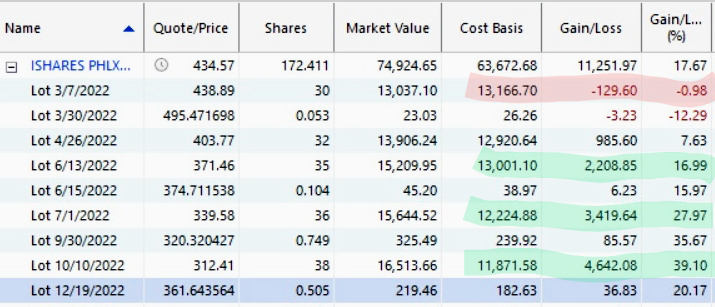
Wow!!! My first ever dabbling in buying on dip  during 2022 market downturn turned out to be quiet exciting endeavor. I primarily bought iShares Semiconductor ETF (SOXX). Let me share my experience from this experiment. Since I don't do market timing in general, I was not sitting on any cash for such buy on low exercise. Rather I used borrowed  funds from HELOC at prime minus 1% (3% average APR during last year) rate. I kept buying little bit on dip each time SOXX went down by 8%. As SOXX dropped around 36% last year, I ended up buying for around 80K. So far, with spectacular recovery of semiconductor sector this year, this experiment has generated almost 20% gain on my investment in it. My plan is to start selling SOXX slowly as it reaches it's record high in near future and keep selling for each 8% increment thereafter. Idea is to slowly pay off HELOC and then repeat this excercise again during next market correction/crash.  Glad to see my first buying on dip experimen...

Why bonds must be always part of our overall portfolio mix

If one's retirement horizon is quite far away, they need not invest any retirement money in bonds. Bond's long term REAL (after inflation) returns are too low (just 2%) as compared to that of stocks (which is 7%). Note that above suggestion of not keeping any retirement savings in bonds for younger (below mid fifties) workers comes with a caveat. It's only meant for savvy  investors (with higher risk tolerance ) who are able to effectively manage pain of loss during stock market downturns and stay course  without losing any sleep. With 100% stock portfolio, pain of loss is expected to be most severe . So, unless you believe in long term potential of stocks and are willing to exercise patient, don't try 100% stock portfolio. Rather, like typical  retirement saver, stay with target date retirement funds (which typically has decent bond allocation) so that short term losses during crashes is emotionally  better manageable for your lower risk tolerance. Near retiree (...

Invesco Taxable Municipal Bond ETF (BAB) - Special muni bonds called Build America Bonds

Special muni  bonds category called Build America Bonds  seems to offer very decent return as safe bond. For example, one of inexpensive etfs in this muni category, Invesco Taxable Municipal Bond ETF (BAB)  , offers 6% coupon rate for half of such bonds in it's portfolio. Overall coupon rate comes out to be in 4.25% range. This seems to have resulted in total return for this ETF for last 1,3,5,10  years timeframe to be in 7.5%  range. This is almost 3% higher  than Total Bond index for similar time horizons. These long term  muni bonds were mainly issued in 2009-2010 by states/municipalities to finance state level major projects to spur growth after 2008 great recession. Federal government has been providing significant (35%) subsidy  towards interest payment to bond issuer . This, in turn, enabled  these bonds to offer better  rates than traditional munis. BAB seems to have outperformed  broad bonds consistently since it's incepti...

How we are likely to witness crypto financial crisis similar to one seen during 2008 CDO financial crisis

"Only when the tide goes out do you discover who's been swimming naked." Quote by Warren Buffett. Perhaps applies to novice crypto speculators who have lost most of their so-called conservative  stable coin high yield savings investment. Perhaps this tide is just a beginning . Bank runs are contagious. Anyone with historical understanding of great depression era bank runs (when there was no concept of FDIC insurance) knows it.  Crypto investing space seems to be crowded by all these saving and loan fintechs involved with unrealistic high-yield  saving products (kind of like 1990 era Indian Kuber  chit fund paying 24% APR interest). Such kind of lending products are based on irrational  assumption that crypto currencies valuation will keep increasing to maintain such high yield. https://www.wsj.com/articles/fdic-scrutinizing-voyagers-marketing-on-safety-of-customer-deposit-accounts-11657212266?st=87j85augzujggle&reflink=desktopwebshare_permalink Also, recent ...

Vanguard Total Stock Market Index etf - VTI

Vanguard Total Stock Market Index etf (VTI) is ETF based on CRSP Total stock market model developed by top UChicago economists. It is a combined index of top 2500 stocks (based on market cap) representing almost 95% of the market cap of total stock market. Vanguard Total Stock Mkt Idx Adm (VTSAX) is underlying mutual fund for this ETF. If one wants to do automatic periodic monthly investment, one should buy VTSAX instead (as most of brokerage allow periodic investment in mutual fund only ). Money invested in a given company is proportional to their market cap weightage and so giant and large cap ones get most of money (70%) and rest goes to mid caps and small caps. S&P 500 based large cap stocks represent approx 70-75% of total domestic stock market capitalization and so investing into a mutual fund/etf based on this index provides a broad large cap  coverage for sure. However remaining 25-30% domestic stocks fall into mid cap (15-20%) and small cap (10-15%) market cap. ...