Posts

SPDR® S&P Semiconductor ETF (XSD) - Excellent small cap semiconductor index fund

Recently I came across another *semiconductor* focused low cost index ETF which seems quite promising index. It's called SPDR S&P Semiconductor ETF ( *XSD*). Unlike iShares Semiconductor ETF SOXX ( https://financial-well-being.blogspot.com/2022/01/iShares-Semiconductor-ETF-SOXX-Passive-Semiconductor-technology-index.html ), which focuses primarily in *large* cap, XSD focuses into *small and mid* cap semiconductor companies of S&P Total index. It's *equal weighted* index and that's why it's average capitalization is in mid and small cap.Overall it's comparable or *even better* than SOXX. For example... - It's PE is comparable to that of SOXX - Dividend yield plus earnings growth of 16% as compared to lower 13% for SOXX - It's 3/5 year returns of 23/22% is 20% better than that of SOXX's 19/18%. It tracks *semiconductor small cap* sector which has been one of the top performer in technology sector with close to *20% annual return* for last 5, 10 an...
iShares MSCI India Small-Cap ETF (SMIN) - Top performing Emerging Asia Pacific index fund ETF

Going forward I am thinking to add an *Emerging* Asia Pacific market ETF called iShares MSCI India Small-Cap ETF ( *SMIN* ). It's *top performer* for last 3 and 5 years period with annual returns of 22% and 13% for this emerging market segment. With 22% long-term *earning growth* projections, it's expected to produce top long-term return. As *country specific* fund, it's certainly concentrated and is more expensive (0.75% expense ratio). However, unlike other top performer ETFs, it's focus is not specific to any hot speculative industry. Also, it's capitalization falls into *mid* cap (borderline large cap) range, making it less aggressive than typical small cap etf. It's P/E of 22 is 10% higher than typical India equity fund. However, it's long term earnings growth projection of 22% is 30% more than it's category. So it's total return potential is still way (20-30%) higher than typical India equity fund. I am planning to build more position into it...

iShares iBoxx $ Invmt Grade Corp Bd ETF (LQD) - Inexpensive Corporate Bond ETF

iShares iBoxx Investment Grade Corporate Bond ETF ( *LQD*) seems to offer 1% better return than Vanguard Total Corporate Bond ETF (VTC). Also it's bonds are better rated (A as compared to BBB) and it's expense ratio of 0.140% is comparable. Vanguard Interm-Term Corp Bd ETF (VCIT) has lower quality (BBB instead of A) and is less diversified. Accordingly, it should have produced better performance (than LQD) due to these added risks. But, it hasn't.

iShares 0-3 Month Treasury Bond ETF (SGOV) - Inexpensive ultra short term treasury bill ETF for emergency fund saving

iShares® 0-3 Month Treasury Bond ETF (SGOV) is ultra short term treasury bill ETF. It's expense ratio is near zero (just 0.07%) and it's latest (last 30 days) yield is 5.28%. Since it primarily holds US government bonds, this ETF is state and local tax exempt. Unlike CDs, there is no early withdrawal penalty. For saving money for emergency fund and short term goal expenses, SGOV seems like a good option. Since it is ultra short term bond fund, principal preservation is as good as any other money market fund.

My first ever dabbling in buying on dip during 2022 market downturn turned out to be quiet exciting endeavor

Image
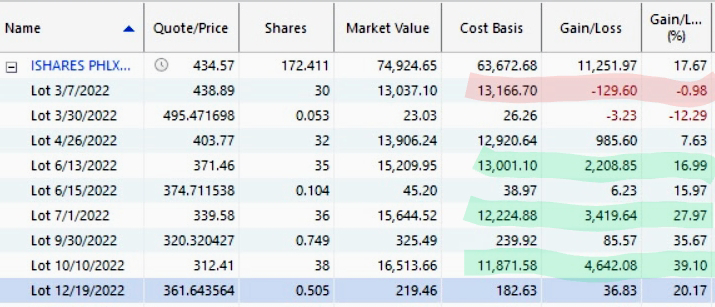
Wow!!! My first ever dabbling in buying on dip  during 2022 market downturn turned out to be quiet exciting endeavor. I primarily bought iShares Semiconductor ETF (SOXX). Let me share my experience from this experiment. Since I don't do market timing in general, I was not sitting on any cash for such buy on low exercise. Rather I used borrowed  funds from HELOC at prime minus 1% (3% average APR during last year) rate. I kept buying little bit on dip each time SOXX went down by 8%. As SOXX dropped around 36% last year, I ended up buying for around 80K. So far, with spectacular recovery of semiconductor sector this year, this experiment has generated almost 20% gain on my investment in it. My plan is to start selling SOXX slowly as it reaches it's record high in near future and keep selling for each 8% increment thereafter. Idea is to slowly pay off HELOC and then repeat this excercise again during next market correction/crash.  Glad to see my first buying on dip experimen...

Why bonds must be always part of our overall portfolio mix

If one's retirement horizon is quite far away, they need not invest any retirement money in bonds. Bond's long term REAL (after inflation) returns are too low (just 2%) as compared to that of stocks (which is 7%). Note that above suggestion of not keeping any retirement savings in bonds for younger (below mid fifties) workers comes with a caveat. It's only meant for savvy  investors (with higher risk tolerance ) who are able to effectively manage pain of loss during stock market downturns and stay course  without losing any sleep. With 100% stock portfolio, pain of loss is expected to be most severe . So, unless you believe in long term potential of stocks and are willing to exercise patient, don't try 100% stock portfolio. Rather, like typical  retirement saver, stay with target date retirement funds (which typically has decent bond allocation) so that short term losses during crashes is emotionally  better manageable for your lower risk tolerance. Near retiree (...

Invesco Taxable Municipal Bond ETF (BAB) - Special muni bonds called Build America Bonds

Special muni  bonds category called Build America Bonds  seems to offer very decent return as safe bond. For example, one of inexpensive etfs in this muni category, Invesco Taxable Municipal Bond ETF (BAB)  , offers 6% coupon rate for half of such bonds in it's portfolio. Overall coupon rate comes out to be in 4.25% range. This seems to have resulted in total return for this ETF for last 1,3,5,10  years timeframe to be in 7.5%  range. This is almost 3% higher  than Total Bond index for similar time horizons. These long term  muni bonds were mainly issued in 2009-2010 by states/municipalities to finance state level major projects to spur growth after 2008 great recession. Federal government has been providing significant (35%) subsidy  towards interest payment to bond issuer . This, in turn, enabled  these bonds to offer better  rates than traditional munis. BAB seems to have outperformed  broad bonds consistently since it's incepti...